What’s the Difference Between Microblading and an Eyebrow Tattoo?
Microblading uses a handheld tool to create individual hair-like strokes in the upper skin layers with pigments that fade naturally over 1-3 years. Traditional eyebrow tattoos use a machine to deposit ink deeper into the dermis permanently, creating a solid filled-in look that often shifts to blue, gray, or orange over time.
“Is microblading basically just a tattoo?”
Short answer: no. Long answer: they’re about as similar as a pencil sketch and a spray-paint stencil. Same general idea—pigment goes under skin—but the technique, the tools, the depth, the look, and the way they age are completely different.
I’ve been doing microblading for 10+ years, with over 3,500 treatments behind me. And in that time, I’ve seen the full spectrum: clients who got beautiful microblading elsewhere, clients who got beautiful microblading from me, and clients who walked in with old eyebrow tattoos they hated and wanted fixed.
So let me break down exactly what separates these two treatments—because understanding the difference is the first step toward getting the right result for your face.
The Technique: Two Completely Different Tools
Traditional Eyebrow Tattoo
A cosmetic tattoo uses a machine—essentially the same type of device a body tattoo artist uses, though sometimes with a smaller needle configuration. The machine rapidly punctures the skin and deposits ink deep into the dermis (the lower, permanent layer of skin).
Key characteristics:
- Machine-driven — motorized needle moves rapidly up and down
- Deeper penetration — reaches the dermis, where ink becomes permanent
- Traditional tattoo ink — formulated to last forever (more on why that’s a problem later)
- Solid fill technique — creates a block of color rather than individual strokes
Microblading
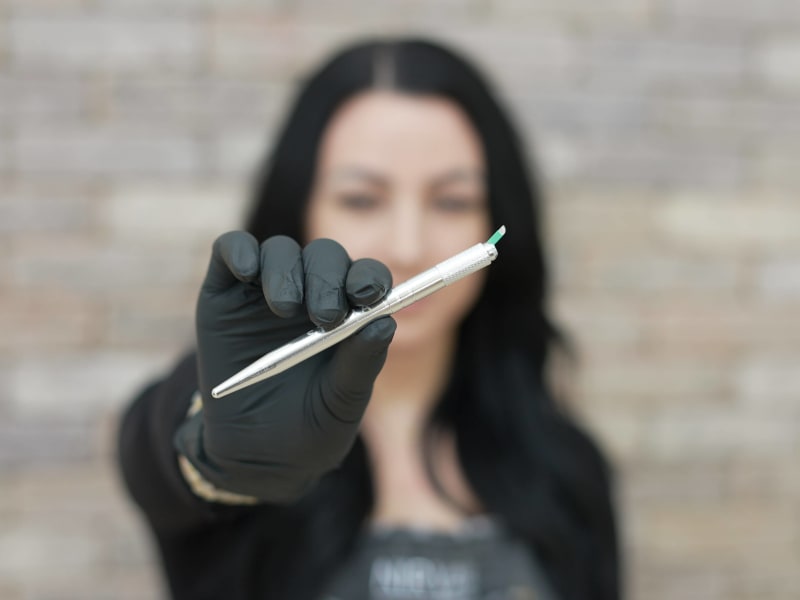
I use a handheld tool—no machine, no buzzing. It’s essentially a small blade made of ultra-fine needles arranged in a row. I manually draw each stroke by hand, one at a time, controlling the depth, pressure, and angle of every single line.
Key characteristics:
- Handheld, manual tool — I control every stroke directly
- Shallower penetration — stays in the upper dermis/epidermis junction
- Specialized PMU pigments — designed to fade gradually over time
- Hair-stroke technique — each stroke mimics one individual brow hair
The difference in control is massive. With a machine, you set the depth and speed and the needle does its thing. With microblading, every stroke is a deliberate, individual decision. It’s slower, yes. But that precision is what makes the result look like real hair instead of a block of color.
How They Look: Natural vs. Obvious
This is the part most people care about—and where the difference is impossible to ignore.
The Tattoo Look
Traditional eyebrow tattoos create a solid, filled-in appearance. Even when done by a skilled artist, they look like makeup that was drawn on. There are no individual strokes, no variation in thickness, no mimicking the natural direction hair grows.
The result often looks:
- Flat and one-dimensional
- Like someone filled in a stencil
- Obvious from a normal conversation distance
- “Done”—in a way that everyone notices
The Microblading Look
Good microblading creates individual hair strokes that blend with your existing brows. Each stroke varies slightly in length, thickness, and curve—just like real brow hairs do. When it’s done right, the result looks like you just happen to have naturally full, well-shaped brows.
The result looks:
- Three-dimensional, with depth and movement
- Like actual hair growing from your skin
- Undetectable from a normal conversation distance
- Natural—in a way that nobody can pinpoint
I tell every client the same thing: natural is non-negotiable. I don’t do brows that look “done.” I do brows that look like they were born there.

How They Age: This Is Where It Really Matters
Fresh results can be deceiving. A new eyebrow tattoo can look fine on day one. But here’s what happens over the next few years—and this is where I’ve seen the most regret.
How Eyebrow Tattoos Age
Traditional tattoo ink wasn’t designed for the face. It was designed for body tattoos, where the skin behaves differently and the ink sits deeper. On your face, here’s what happens over time:
- Color shifts dramatically — Black ink turns blue-gray. Brown ink turns orange or red. This isn’t a maybe—it’s chemistry. The pigments break down under UV exposure and your body’s natural processes.
- Edges blur and spread — The ink migrates outward over years, making your brows look larger and less defined than the original shape.
- The shape doesn’t adapt — Your face changes as you age. An eyebrow tattoo stays exactly where it was put, even as everything around it shifts.
- It’s permanent — Unlike microblading, it doesn’t fade away on its own. You’re stuck with whatever it becomes.
I’ve had clients come to me with 10-year-old eyebrow tattoos that had turned a blue-green color. They looked bruised, not beautiful.
How Microblading Ages
Microblading uses pigments specifically formulated for the face. They’re designed to fade gradually and predictably. Here’s the timeline:
- Year 1: Strokes look crisp and natural. Color is warm and accurate.
- Year 1-2: Gradual, even fading. Strokes soften slightly but still look like hair.
- Year 2-3: Faded enough that you’d want a refresh, but it still looks natural—just lighter.
- Year 3+: Most clients have faded significantly or completely. No weird color shifts, no blue undertones.
The key difference: microblading fades out, while tattoos fade weird. When microblading fades, it just gets lighter. When a tattoo fades, it changes color entirely—and not in a good way.
This is why I choose pigments over ink, every time. Color that heals soft and stays balanced is part of my process from the start.
Pain Comparison: What Hurts More?
Most clients who’ve had both say microblading hurts less—it’s a manual scratching sensation with pauses between strokes, versus a machine’s continuous buzzing vibration.
Neither option is pain-free—I’m always honest about that. But the experiences are different.
Eyebrow Tattoo Pain
The machine creates a rapid, buzzing vibration as the needle punctures the skin repeatedly at high speed. Most people describe it as:
- A constant vibrating sting
- Louder and more intense than expected
- More uncomfortable on bony areas near the brow ridge
- Similar to a body tattoo but in a more sensitive area
Microblading Pain
Since I’m using a handheld tool and making individual strokes, the sensation is different:
- A scratching or light scraping feeling
- More like eyebrow plucking in reverse
- Quieter (no machine buzzing)
- Easier to manage because there are natural pauses between strokes
I covered the full breakdown in The Truth About Microblading Pain—including real data from 3,500+ clients. The short version: 81% of my clients rate microblading a 5 or below on a 10-point pain scale.
Most people who’ve had both done say microblading was less painful. The manual, stroke-by-stroke approach gives your body small breaks that a machine doesn’t.
I use topical numbing before and during the session, and I’ve never had a single client unable to finish. Not once in 10+ years.
Who Is Each One Best For?
Microblading is better for anyone who wants natural-looking, adjustable results that fade gracefully. Traditional brow tattoos only suit people who want a permanent, bold makeup look.
Eyebrow Tattoos Might Work If You:
- Want a permanently filled, makeup-like look and are okay with that
- Prefer very bold, defined brows that always look “done”
- Don’t mind the maintenance of laser removal if you change your mind
- Have tried everything else and need full permanent coverage
Honestly, I rarely recommend traditional tattooing for brows. The color-shift issue alone makes it a risky choice.
Microblading Is Better If You:
- Want natural-looking results that nobody can tell aren’t real
- Like the idea of brows that look like they were born there
- Prefer the flexibility to adjust your shape and color over time
- Want something that fades gracefully rather than permanently
- Have sparse, thin, or over-plucked brows you want to fill in
- Are recovering from medical hair loss and want a natural restoration
If you’re curious whether you’re a good candidate, I wrote a full candidate checklist that covers skin type, medical factors, and lifestyle considerations.
The Combination Option: Best of Both Worlds
For clients who want a bit more definition than microblading alone—but still nothing close to a traditional tattoo look—there’s a third option: combination brows.
Combination brows use microblading hair strokes at the front of the brow (where hair naturally looks more sparse and individual) and add soft pixel shading through the body and tail (where a fuller, more “filled in” look is natural).
The result is:
- Hair strokes where they matter most (the front/inner brow)
- Soft shading for depth and fullness (the body and tail)
- Still completely natural-looking
- Lasts a bit longer than microblading alone
- Great for oily skin types where pure hair strokes might blur faster
I do one thing—and I do it exceptionally well. Whether that’s classic microblading or combination brows, every technique I use is designed to give you hyper-realistic results that match your face, your skin, and your lifestyle.
”What If I Already Have an Eyebrow Tattoo?”
Faded tattoos can often be microbladed over directly. Dark or color-shifted tattoos may need laser lightening or color correction first, but correction is absolutely possible.
This is more common than you’d think. I work with clients who have old cosmetic tattoos all the time—whether they’ve faded to that telltale blue-gray, spread beyond the original shape, or just don’t look like what the client wants anymore.
Here’s what the correction process looks like:
If the Tattoo Has Faded Significantly
Good news: faded tattoos are the easiest to work with. If the ink has lightened to a soft gray or the color has mostly washed out, I can often microblade right over it. The new hair strokes blend with the remaining pigment, and the result can look surprisingly natural.
If the Tattoo Is Still Dark or Has Strong Color
This is trickier. Dark, saturated tattoo ink can show through microblading strokes and compete with the new pigment. In these cases, I might recommend:
- Laser lightening first — A few sessions of laser treatment to break down the old ink before I microblade. This doesn’t have to fully remove the tattoo—just lighten it enough to work over.
- Color correction — Using specific pigment tones to neutralize unwanted undertones (orange, blue, gray) before adding natural-looking strokes.
- A combination approach — Shading techniques can be more effective than pure hair strokes when covering old tattoo work.
If the Shape Is Wrong
Old tattoos that were placed in the wrong position or don’t match your current face shape need careful planning. I map the new shape around what’s there, sometimes incorporating the old work and sometimes designing around it.
The Honest Truth About Corrections
Corrections take more time, more sessions, and more patience than starting fresh. I won’t sugarcoat that. But I’ve helped dozens of clients go from “I hate my old tattoo” to “I actually love my brows now.” It’s doable—it just requires realistic expectations and a solid plan.
If you have an old eyebrow tattoo and want to explore your options, book a consultation. I need to see the tattoo in person to give you an honest assessment of what’s possible.
The Side-by-Side Breakdown
Here’s everything in one place:
| Factor | Eyebrow Tattoo | Microblading |
|---|---|---|
| Tool | Electric machine | Handheld blade |
| Pigment depth | Deep dermis | Upper dermis |
| Pigment type | Tattoo ink | PMU pigment |
| Look | Solid, filled block | Individual hair strokes |
| Longevity | Permanent | 1-3 years |
| Fading | Turns blue/gray/orange | Fades evenly, lightens naturally |
| Pain level | Moderate-high | Mild-moderate |
| Natural appearance | Low (looks like makeup) | High (looks like real hair) |
| Adjustability | Requires laser removal | Fades on its own, refreshable |
| Session time | 1-2 hours | 2-3 hours (including mapping & numbing) |
| Touch-up at 6-8 weeks | Varies | $150 (required for best results) |
Making Your Decision
If you’ve read this far, you’re probably leaning one way already. And if you’re drawn to the idea of brows that look like they were born there—natural, realistic, and designed specifically for your face—microblading is almost certainly the better fit. If cost is part of your decision, my Microblading Cost Calculator breaks down the real investment versus what you’re currently spending on daily brow products.
If you’re searching for eyebrow microblading near me, the decision between these two treatments matters more than most people realize—because permanence cuts both ways.
Here’s what I’d do:
- Read more about the process — My post on what is microblading covers every step from consultation to healed results
- Browse real results — Check out my before and afters to see healed microblading on real clients with real skin
- Book a free consultation — Come in, ask every question, and get an honest assessment of what’s right for YOUR brows
No pressure, no obligation. If microblading isn’t the right choice for your skin type or situation, I’ll tell you that. Because the right shape changes everything—but only when it’s done the right way.
My studio is in Shorewood, IL, and I work with clients from across the southwest suburbs. If you’re coming from Plainfield, Bolingbrook, Downers Grove, or Woodridge, you’re just a short drive away.
Have questions about microblading vs. tattoo for your specific situation? Contact me — I answer every message personally.